
Beaver
Cumberland wildlife park Grünau loop road
Cumberland Wildpark Grünau
Grünau, Austria
8873 Visits
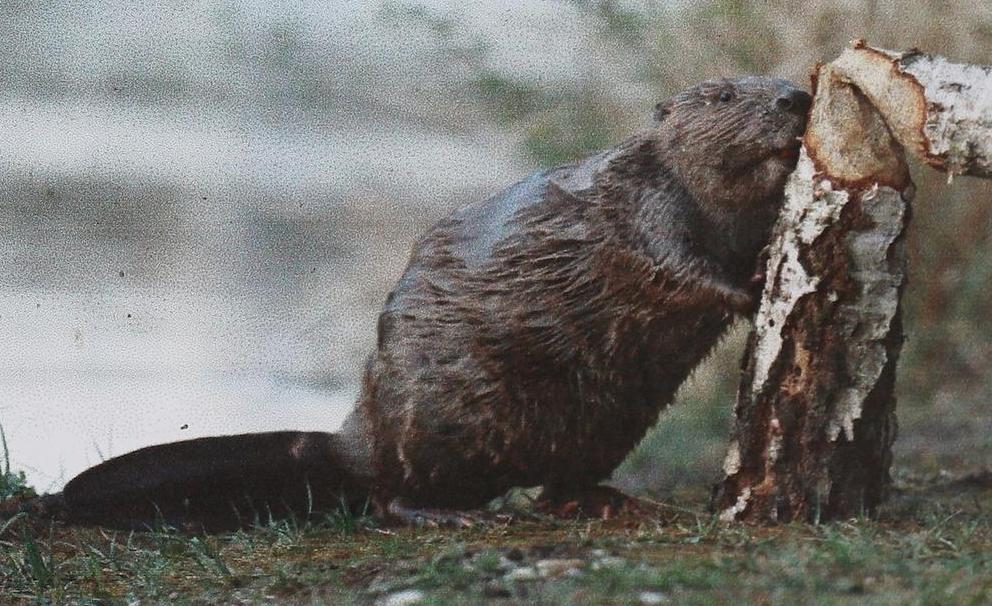
The gregarious beaver lives monogamous in a family group. From branches, twigs and mud, he builds "beavers" on shallow shores with access under the water surface. To keep the water level constant, the beaver builds dams. With its eye-catching teeth it can cut trees up to 80 cm thickness! The teeth have an orange enamel coating that makes the teeth hard. These grow up to 3.5 cm long and grow for a lifetime. With its dense fur and the flattened tail, the trowel, the beaver is well adapted to life in the water. It can dive up to 20 minutes.
The beaver, which had almost been eradicated in Europe, has been voted "animal of the year". He was eaten in the meatless Lent due to his "fish-like tail" and was thus highly decimated. The beaver was able to recapture only by reintroduction and strict protection measures its habitats like meadows and river landscapes. It is one of the few animals that helps shape their environment. Beavers live in caves that they dig in riverbanks, are monogamous and pure herbivores. In winter, they feed on young bark and small twigs of treetops, which they get by cutting down the trees.
Species name: Beaver
Scientific name: Castor fiber
Class: Mammals
Order: rodents
Family: Beaver
Weight: up to 30 kg
Characteristics: Squat body, short legs, webbed feet, brown to blackish-brown, very dense fur, slightly lighter on the ventral side, split cleaning claw on the second toe. Typical feature is the flattened, up to 16 cm wide hairless tail, the trowel
Did you know, that ...
the trowel of the beaver serves as a control during descent, as well as for temperature regulation and as a fat depot?
The beaver, which had almost been eradicated in Europe, has been voted "animal of the year". He was eaten in the meatless Lent due to his "fish-like tail" and was thus highly decimated. The beaver was able to recapture only by reintroduction and strict protection measures its habitats like meadows and river landscapes. It is one of the few animals that helps shape their environment. Beavers live in caves that they dig in riverbanks, are monogamous and pure herbivores. In winter, they feed on young bark and small twigs of treetops, which they get by cutting down the trees.
Species name: Beaver
Scientific name: Castor fiber
Class: Mammals
Order: rodents
Family: Beaver
Weight: up to 30 kg
Characteristics: Squat body, short legs, webbed feet, brown to blackish-brown, very dense fur, slightly lighter on the ventral side, split cleaning claw on the second toe. Typical feature is the flattened, up to 16 cm wide hairless tail, the trowel
Did you know, that ...
the trowel of the beaver serves as a control during descent, as well as for temperature regulation and as a fat depot?
all exhibitions containing this object
Similar
Nica Junker
18763 Visits
1. Introduction
Geschichte Kloster Traunkirchen
21684 Visits
K. u. F. Drack GmbH & Co KG
Xplore Energy
22380 Visits
ANTI-FORM
13234 Visits
Heidi Zednik
Kunst:Raum Gmunden
11746 Visits
Marie-José Gröger
11873 Visits
Markus Moser
WireART - Markus Moser
10090 Visits
Xplore Energy
24588 Visits
Sylvia Vorwagner
Skateshop Hammerschmid
11476 Visits
UPPER ART - Aktuelle Positionen aus Oberösterreich. Ausstellung in der Galerie im Granitmuseum Schärding
Angelika Doppelbauer
8380 Visits
TVB-Mölltal © Reinhard Kager
Tourismusverband Mölltal
7460 Visits
Giovi Artworks
16259 Visits
Blindness & Art
Bundes-Blindenerziehungsinstitut
3216 Visits
Markus Moser
WireART - Markus Moser
19063 Visits
Xplore Energy
23841 Visits
Universität Innsbruck
Xplore Energy
11475 Visits
TVB-Mölltal © Franz Gerdl
Tourismusverband Mölltal
6996 Visits
TVB Ferienregion Traunsee
Region_Traunsee
18740 Visits
Markus Moser
WireART - Markus Moser
10468 Visits
Michael Wabro
Skateshop Hammerschmid
23065 Visits